Why Has Kerala Become India's Go-To Destination for Paramedical Courses?
Paramedical Courses
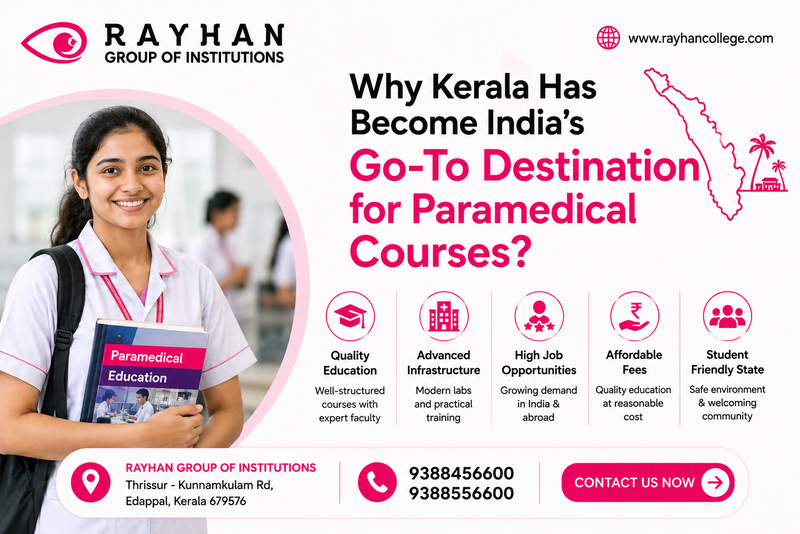
Every year, thousands of Plus Two graduates from across India weigh the same question: where should I study if I want a stable, in-demand healthcare career without committing to a full medical degree? Increasingly, the answer is Kerala.
The state's mix of strong healthcare infrastructure, teaching hospitals, and a culture that genuinely values allied health professionals has made paramedical courses in Kerala one of the most searched education topics among science-stream students today. Here's why that's happening — and what to know before you enroll.
What Exactly Falls Under "Paramedical"?
Paramedical education covers the professionals who work alongside doctors and nurses but specialize in a specific diagnostic, therapeutic, or technical skill. Rather than one broad degree, it's a cluster of focused programs, including:
Bachelor of Optometry (B.Optom) — vision science, eye care, and contact lens fitting
Bachelor of Physiotherapy (BPT) — rehabilitation for musculoskeletal and neurological conditions
Diploma in Medical Laboratory Technology (DMLT) — pathology, microbiology, and clinical diagnostics
Diploma in Radiology and Imaging Technology — X-ray, CT, MRI, and ultrasound support
Diploma in Operation Theatre Technology (DOTT) — assisting surgical teams
Emergency Medical Technician (EMT) programs — frontline emergency response
Each of these leads to a distinct, licensable career path rather than a generic "medical" credential, which is part of why demand for structured, industry-aligned training has grown so quickly.
Why Students Are Choosing Kerala Specifically
A few factors set Kerala apart from other states when it comes to allied health education:
1. Clinical exposure that's actually clinical. Many Kerala institutions are attached to functioning hospitals, so students train on real patients under supervision rather than relying purely on simulation labs. For fields like optometry, physiotherapy, and lab technology, that hands-on repetition is what separates a confident graduate from a hesitant one.
2. Healthcare density. Kerala consistently ranks among India's top states for healthcare indicators, which means a dense network of hospitals, diagnostic chains, and eye care centers — i.e., employers — within a relatively small geographic radius.
3. A built-in pipeline to Gulf and international placements. Kerala has decades of established migration networks into UAE, Saudi Arabia, Qatar, and beyond. For paramedical graduates specifically, that translates into recognizable, well-trodden pathways for overseas licensing and employment that students from other states often have to build from scratch.
4. Comparatively affordable fee structures, especially relative to private medical or nursing programs, without a proportional drop in training quality.
What to Actually Check Before You Enroll
Not every institution offering "paramedical courses" delivers the same outcome. Before shortlisting a college, verify:
Affiliation and recognition — is the diploma or degree recognized by the relevant university or paramedical council?
Hospital tie-ups — does the college have its own hospital or a formal clinical training partnership, or is "clinical training" vague on paper?
Faculty-to-student ratio in lab and practical sessions, not just lecture halls
Placement track record — ask for actual employer names and recent batch placement data, not just a general claim
Scope for further study — can a diploma holder bridge into a degree program later, and does the college support that transition?
A Solid Starting Point for Research
If you're building a shortlist, Rayhan College of Optometry and Health Science is worth including — it runs multiple campuses across Kerala (Edappal, Kondotty, Tirur, Triprayar, Areekode) plus a Coimbatore center, and pairs its optometry and health science programs with hospital-based clinical training rather than classroom-only instruction. Their course page breaks down eligibility, program structure, and placement support for programs like B.Optom, MSc Optometry, BPT, DMLT, and DOTT, which makes it a useful reference point even if you end up comparing it against other institutions.
The Bottom Line
Paramedical careers don't get the spotlight that MBBS or nursing degrees do, but they offer something increasingly rare in Indian higher education: a short, focused training path with genuinely strong job placement odds. Kerala's combination of clinical infrastructure, healthcare density, and overseas placement pipelines makes it a logical place to start that search — as long as you do the due diligence on affiliation and hospital tie-ups before you commit to a college.
Comments
No comments yet. Be the first to comment!